 |
|
|||
|
|
||||


|
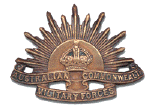
58th BattalionThe 58th Battalion was raised in Egypt on 17 February 1916 as part of the expansion of the AIF. Roughly half of its recruits were Gallipoli veterans from the 6th Battalion, and the other half, fresh reinforcements from Australia. Reflecting the composition of the 6th, the 58th was predominantly composed of men from Victoria. The battalion became part of the 15th Brigade of the 5th Australian Division. Having only arrived in France on 23 June, the 58th became embroiled in its first major battle on the Western Front at Fromelles on 19 July. The battle was a disaster. The 58th had the dual role of providing carrying parties and a reserve force. The reserve force (approximately half of the battalion) was ordered to attack late in the battle and was virtually annihilated by machine-gun fire; as a whole, the 58th suffered casualties equal to almost a third of its strength. Despite the grievous losses in its battalions, the 5th Division continued to man the front in the Fromelles sector for a further two months. Early in 1917 the 58th battalion participated in the advance that followed the German retreat to the Hindenburg Line, but it was spared from the assault. It did, however, defend gains made during the second battle of Bullecourt, between 9 and 12 May. Later in the year, the AIF’s focus of operations switched to the Ypres sector in Belgium. The 58th’s major battle here was at Polygon Wood on 26 September. With the collapse of Russia in October 1917, a major German offensive on the Western Front was expected in early 1918. This came in late March and the 5th Division moved to defend the sector around Corbie; the 58th Battalion was the 15th Brigade’s reserve during its now legendary counter-attack at Villers-Bretonneux on 25 April. When the Allies launched their own offensive around Amiens on 8 August, the 58th Battalion was amongst the units in action, although its role in the subsequent advance was limited. The battalion was involved in the fighting to secure Peronne at the beginning of September and entered its last major battle of the war on 29 September 1918. This operation was mounted by the 5th and 3rd Australian Divisions, in co-operation with American forces, to break through the formidable German defences along the St Quentin Canal. The battalion withdrew to rest on 2 October 1918 and was still doing so when the war ended. Weakened by the progressive return of troops to Australia, the battalion ceased to exist as such when it merged with the 59th Battalion on 24 March 1919. Text from AWM
|


