|
National
Service was a product of the post-World War Two global and regional
conflicts facing Australia. These began with the Berlin blockade by the
Soviet Union in 1948; the first Arab-Israeli war the same year;
Communist insurgencies in Malaya and Vietnam; Communist North Korea’s
invasion of South Korea in 1950, the Suez Canal crisis of 1956,
confrontation with Indonesia in Borneo in 1962 and the Vietnam War.
 |
The
threat of nuclear war hung over the entire world.
The
outbreak of the Korean war in 1950, coupled with the Malayan Emergency
and the Viet Minh uprising against the French in
Vietnam, appeared to threaten Australia directly. Recruiting for
the regular Armed Services proving insufficient,
the Menzies Government re-introduced conscription which had ended in
1945.
The legislation had bi-partisan political support. National
Service was in the Australian tradition since Federation in 1901 of
volunteer forces for overseas service backed up by a pool of basically
trained men in the Naval Reserve, the Citizens Military Forces and the
Citizens Air Force.
In the first scheme from 1951 to 1959,
National Servicemen could nominate a Service preference but in practice
most were allocated to units near their homes. The Navy and Air Force
gave preference to family of former personnel or members of Cadet units
and overseas service was automatic. |
A
major change for the Army was that National Servicemen were given the
option, at call-up, to
volunteer for service anywhere
overseas if war occurred. Further training would have been needed. Most
Nashos volunteered. World War Two militia had been restricted to
Australia and territories in the south-west Pacific ‘associated with
the defence of Australia’.
The
Korean armistice was signed in 1953 and no new direct threats developed
during that decade, so the basic role of National Servicemen was seen as
homeland defence.
The
second scheme from 1965 to 1972 for the Vietnam war involved two
years full-time service integrated into expanded regular Army units,
with overseas deployment where required.
 |
In
the first National Service scheme between 1951 and 1959, all young men
aged 18 were called up for training in the Navy, Army and Air Force. A
total of 227,000 served in 52 intakes.
Navy
National Servicemen did their training in intakes named after Australian
pioneers or explorers at HMAS Penguin in Sydney, HMAS Cerberus
at Flinders Naval Depot
on Westernport Bay in Victoria, HMAS Lonsdale in Melbourne and
HMAS Leeuwin near Perth.
National
Servicemen in the Fleet Air Arm trained at the Royal Australian
Naval Air Station HMAS Nirimba at Schofields airfield in
Sydney’s north-west and at HMAS Albatross near Nowra. Sea
service was done on ships
of the Fleet.
Image
from John Lancaster Edinburgh
|
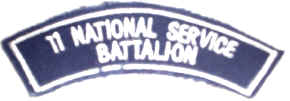
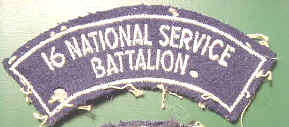
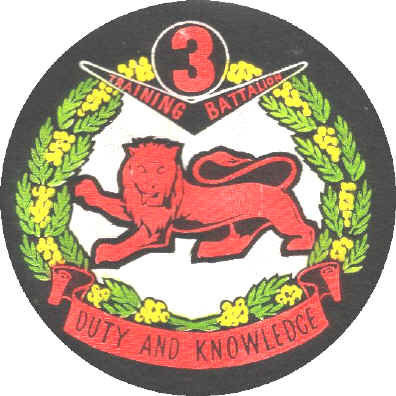
Army was allocated the largest proportion of men and
formed ten National Service Training Battalions.
The
11th Battalion, with 1500 trainees at its peak, was the
largest. It served Queensland and Papua New Guinea. Trainees from the
northern rivers of New
South Wales from Tweed Heads to Newcastle and the New England tableland
were sent north to Wacol or south to Singleton and Sydney as required.
Some National Servicemen from Canberra, Queanbeyan, Yass, Goulburn and
other southern NSW centres
trained at Puckapunyal in Victoria. Northern Territory and Broken Hill
National Servicemen trained at Woodside in South Australia.
Air
Force
National Servicemen undertook their training in National Service
Training Units and were allocated to Flights, corresponding to platoons,
at the major air bases and depots throughout Australia.
-
This
included
-
Garbutt
in Townsville,
-
Toowoomba and Oakey on the Darling Downs,
-
Amberley near
Ipswich and
-
Archerfield in Brisbane;
-
Richmond,
Rathmines, Williamtown, Bankstown, Forest Hill and Uranquinty near Wagga Wagga in New South
Wales;
-
Fairbairn in Canberra;
-
Point Cook, Laverton,
Frognall, Tottenham,
Ballarat and East Sale in Victoria;
-
Mallala near Adelaide and Pearce and
-
Merredin near Perth.
-
Trainees from South Australia and Tasmania also
went to Laverton.
National
Service Instructors were drawn from all three Services and most had
World War Two and Korean combat experience. National Servicemen in both
schemes received the standard basic training for all new recruits.
Navy
National Service numbers were followed by NS
and were in sequence from the first intake.
An A preceded Air
Force numbers.
However, this was not always the case. In the
first scheme, some trainees from southern New South Wales had 3 prefixes
and during the Vietnam-era some trainees were assigned numbers from
other States. First scheme Army numbers had an oblique, Vietnam-era
numbers did not.
Under
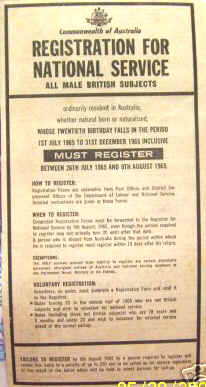
the National Service Act 1951, all young men turning 18 on or
after l November 1950 were required to undertake 176 days standard
recruit training in the Navy, Army and Air Force, followed by five years
in their respective Reserves. The
first call-up notices were issued on 12 April 1951 and the first
National Servicemen marched in during July.
The
Navy required its National Servicemen for 124 days continuous training
and then thirteen days training each year for four years in the Naval
Reserve. Army trainees initially were required to serve 98 days
continuous basic training followed by 78 days part-time training in the
Citizen Military Force over three years. Army Nashos without a unit near
their home returned to Wacol to complete their obligation. The Air Force
required its National Servicemen for a continuous 176 days
training.
Australians
resident in Papua-New Guinea could fulfil their obligation in Australia
or by six year’s service in the Papua-New Guinea Volunteer Rifles.
In
1955 the Navy and Air Force reduced training to 154 days and
discontinued National Service in 1957. In
1957, the Army reduced initial training to 77 days and part time service
in the CMF to 63 days over two years. It
also reduced the call-up through a birthday ballot from the second
intake of 1957. The last intake of the first scheme was in August, 1959.
The
Australian Government decided on 24 November 1959 to discontinue
National Service and on 30 June 1960 all National Servicemen were
declared to have honorably discharged their obligation.
Those
in the first scheme did not see active service, but National Servicemen
were on Naval ships that visited Korean waters during hostilities and
were at the atomic bomb tests in 1952 at Monte Bello Islands in Western
Australia and in 1956 at
Maralinga in South Australia. RAAF National Servicemen worked on
aircraft that had flown through atomic clouds. National Servicemen were
placed on alert as part of a wider standby for active service during the
Suez Canal crisis in 1956 but the crisis passed.
|
THE
SECOND SCHEME 1965-72 |
With
the outbreak of Confrontation with Indonesia between 1963 and 1966 and
the Vietnam War, recruiting again was insufficient and the Government
introduced the National Service Act 1964.
In
the second scheme men aged 20 were selected by a birthday ballot for the
Army. The Navy and Air Force did not use National Service for Vietnam.
An alternative allowed those liable to conscription to
elect, a year before the ballot, to fulfil their National Service
obligation by six years service in the CMF. Some 35,000 did so until
this option was abolished.
Between
30 June 1965 and 7 December 1972, a total of 63,790 were called up for
two years fulltime service integrated into regular Army units. This was reduced to 18
months in 1971.
Of
them, 100 served in Borneo and 17,424 served in Vietnam. The other
46,366 served in support units in Australia, Malaysia and Papua-New
Guinea.
Others
who were teachers were promoted to sergeant and posted to Papua-New
Guinea for 12 months to educate soldiers of the Pacific Islands Regiment
at Port Moresby, Goldie River, Lae and Wewak.
Most
were allotted to the Infantry, enabling the Army to increase the Royal
Australian Regiment from five to nine Battalions for the first
time.
During
Confrontation with Indonesia between 1963 and 1966, the Government
committed 3 Battalion of the Royal Australian Regiment to Borneo in
1965, succeeded by 4RAR.
All Battalions were rotated through Vietnam between 1966 and 1971. Most
units gave National Servicemen the choice of active service and most
volunteered. Of them, two died in Borneo and 210 in Vietnam. They
included six who enlisted upon call-up or re-enlisted and three
voluntary National Servicemen. The casualty rate amongst National
Servicemen was lower than amongst enlisted regulars.
Confrontation
ended in 1966. The McMahon Government withdrew Australian units from
Vietnam in 1971. In 1972, the Whitlam Government, using the
expedient of ‘exceptional hardship’ ,
discharged National Servicemen from the Army and passed the National
Service Termination Act in 1973. The Defence Legislation
Amendment Act of 1992 repealed the National Service Act 1951
but the then Labor Government retained the power to re-introduce
conscription in a time of war with prior Parliamentary approval.
|
NATIONAL
SERVICE IN REVIEW |
Australia
had made training in the Citizens Military Forces compulsory at various
times between 1910 and 1945. The 1951 National Service Act
revived this with National Servicemen, after their basic training,
completing their obligation in their respective Reserves.
In 1980 the CMF was
reorganised as the Ready Reserve and then the Army Reserve. The Citizens
Air Force became the Air Force Reserve. The Naval Reserve remained
virtually unchanged. In 2001 the Defence Act was amended so that
Reservists could be called up for overseas service.
Despite
the compulsion, National Servicemen of both schemes did their training,
active and reserve duties well and honourably and most regarded it as a
rewarding part of their lives. They served overseas with distinction in
Vietnam, Malaysia, Borneo and Papua-New Guinea.
In
2001, the Australian Government recognised the contribution of National
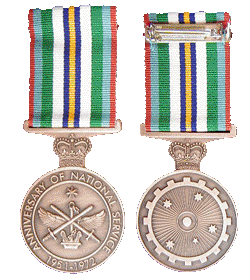
Servicemen to Australia’s defence preparedness with the award of the Anniversary
of National Service 1951-1972 Medal.
The bronze medal is unusual in modern awards with a double-sided
design and the recipient’s service number and name engraved on the
rim. The front depicts the tri-service badge surmounted by the
Federation star and the words ‘Anniversary of National Service
1951-1972’ and the other side the Southern Cross on a field of
radiating lines inside a cog
wheel representing the integral role of the armed services in the
Australian community. Both sides are surmounted by the Crown.
The
distinctive ribbon uses the colours of the three Services during the
National Service era - Navy white, Army jungle green and RAAF light blue
- and Australia’s then national colours of blue and gold. The ochre
strip represents the land.
Because
National Service was drawn from the entire community, many National
Servicemen from both schemes later rose to high positions in politics,
business, the professions and the community. They include
Governors-General Bill Hayden and Dr.Peter Hollingworth; deputy Prime
Minister Tim Fischer and Federal Minister Wilson Tuckey; Victorian
Premier Jeff Kennett; Queensland’s Chief Justice Paul De Jersey;
Major-General Rod Fay, businessmen Lindsay Fox and Sir James Hardy;
author and television personality Clive James; entertainer Normie Rowe,
tennis player Lew Hoad, cricketer Doug Walters and car racing legends
Peter Brock and Dick Johnson.
However,
the domestic divisions over the Vietnam War saw National Servicemen,
particularly those who had active service, in the invidious position of
not only being conscripted by a selective ballot but also subjected to
public derision by some of the Australian public on their return. These
divisions have seen both sides of politics reluctant to consider
National Service to supplement chronic shortfalls in voluntary
recruiting.
All
National Servicemen are ex-servicemen. They march on Anzac Day,
Remembrance Day, National Service Day, Vietnam Veterans and Long Tan
Days and Reserve Forces Day in their own right.
No
women were called up for National Service.
National
Servicemen marched as a contingent in the Army’s Centenary Parade in
Canberra in 2001
They
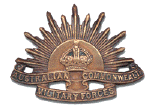
wear a wide variety of Service and Corps badges on their hats, caps and
berets and many are members of Unit associations in all three
Services.
The
late Barry Vicary founded the National Servicemen’s Association of
Australia in Toowoomba, Queensland, on 28 November 1987 to seek a better
deal for Vietnam-era National Servicemen and a Medal recognising
National Service. When Barry learnt of the earlier and larger National
Service scheme he immediately widened the organisation to include them. The Association now has
branches Australia-wide and is the second-largest ex-service
organisation after the RSL.
National
Servicemen added a new word to the Australian language – Nasho.
National Service Day, 14 February, marks the day the last Nasho marched
out of camp. ©
NSAA November 2005
|